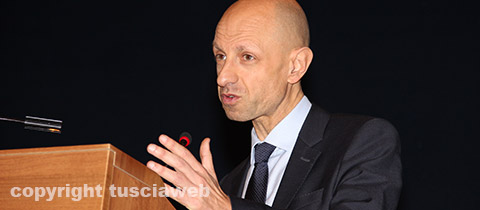
 Il rettore dell’Università della Tuscia Alessandro Ruggieri |
Bruxelles – Riceviamo e pubblichiamo il discorso che il rettore Alessandro Ruggieri ha fatto durante il convegno sulla crescita economica – Dear Members of the European Commission, (professors, academics and) colleagues, and guests, I am honored to be here and, on behalf of the University of La Tuscia, I wish to extend a warm welcome to all of you attending this important event devoted to the theme of Circular Economy and Research.
I would like to take this opportunity to greet the representative of the European Commission and I also take great pleasure in acknowledging the presence and contribution of the delegates of the Italian Ministry of the Environment and the Region of Lazio, with whom we have organized this conference/meeting.
Today’s event is an important occasion to enhance the progress of the European economy towards greater sustainability: it is an opportunity for us to compare our ideas on the issues of Circular economy and reflect on the information presented.
There are several reasons for such an interest in Circular Economy.
Sustainability and environmental impact are directing us towards a paradigm shift involving a circular economic model relying on three strategic elements: the design of the product and the process, the business model and the development model, consumer behavior.
These aspects are linked by enabling factors such as policies, training activities, technology and financial tools.
We must make an effort to reduce the amount of natural and energy resources used in the creation of a product or service, and, at the same time, increase the possibilities of the same resources being reused at the end of a product life cycle.
These elements, if extended to a system level rather than just to individual companies, can help generate huge savings and economic benefits for the entire community. This change will positively affect opportunities and business models.
The adoption of new design patterns will allow ” short -term” recycling processes , while the combination of products and services will result in the development of new opportunities for the creation of added value.
One of the factors enabling circular economy is consumer behavior. It is necessary to stimulate a change in consumption habits, which must be led by a general change in consumer and producer culture.
The strategies that, in our view, the European Union should adopt to promote the Circular Economy can be summarized as follows:
Create links among companies that have already adopted this system, ensuring that the waste produced by a firm can become secondary raw material for another;
Use European funds to promote the development of the Circular Economy and the creation of collaboration networks that can transform waste in secondary raw materials and feed a structured system of continuous circularity, as if it were a large supply chain;
invest in skills of new professionals operating in this new market. It is indeed necessary to raise the level of education and increase the training who will manage a complex system that requires the integration of multiple production systems;
invest in a new cultural approach, based on a shared vision of sustainable development and applicable to businesses and consumers;
promote enterprise networks, also with the help of the Universities, by providing specific expertise in terms of innovation, environmental friendliness, and zero impact actions (or at least actions having “near- zero” impact);
promote, at a European level, the identification of the products of Circular economy by branding (them) and conducting an awareness campaign to avoid consumers’ confusion.
The strong local component that characterizes the Circular economy is part of the transition process which universities started long ago and which consists in the implementation of the so called “third mission” of the university system.
The University of La Tuscia has embarked upon an entrepreneurial journey to stimulate and support research and innovation with the purpose of strengthening ties with the surrounding region and the economic system and of pursuing renewal based on the principles of circular economy, seen as a valuable response to the international economic crisis.
The change promoted by the University consists in involving all local and regional stakeholders in discussions on completely new topics such as the capabilities of transforming the traditional development model of the linear economy in a new model of industrial sustainability.
/With this commitment in mind the University of La Tuscia has proposed the creation of an interdisciplinary center for the study, simulation and application of development models of circular economy. Thanks to the interdisciplinary skills developed in the different fields of expertise at the University, (agro-forestry, bio- and nano- technology, green chemistry, engineering and economics), as well as to cutting-edge equipment and laboratories, the center will be able to work with the local region towards a Circular Economy and to transfer good practices and realize projects having a positive effect on the efficiency of enterprises, a value for consumers and environmental benefits to the entire community.
The aim is to establish, along with other Lazio-based universities, both Italian and European, a privileged channel for communication with European institutions, and to promote real-time exchange and sharing of good practices and empirical experiences.
The Centre will also be engaged in training new professionals, Circular economy specialists, able to operate in this new market and to exploit its business opportunities.
A higher level of education is indeed a necessary prerequisite for the management of a complex system that shifts the focus from the workplace to a more general perspective of growth making training increasingly connected and responsive to business needs.
The University of La Tuscia is at the forefront of the Circular economy challenge, and is helping local businesses to develop eco-innovative projects.
Our hope is that our contribution to the organization of this event, with the participation of the European Commission and Lazio Region, may be the first step towards local and European cooperation to generate circular economy pilot systems in the short and very short term, and to help boost socio-economic and technological development in Europe and its regions.
I hope you will find the conference enjoyable and very useful.
Thank you
Alessandro Ruggieri
Rettore dell’università della Tuscia